
Leak detector with camera LD 500/510
Create an ISO 50001 report with leak detector LD 500 with camera and leakage calculation (l/min and costs in €).
Compressed air optimisation should always begin on the demand side. Leaks, unnecessary venting, excessive operating pressures or inefficiently operated consumers increase the actual demand for compressed air. If compressed air generation is initially designed or optimised to meet this increased demand, the supply side is tailored to existing losses.
In the case of new or replacement investments, this can lead to the selection of oversized compressors. In existing systems, the subsequent elimination of leaks or other reductions in consumption can result in unfavourable operating conditions, such as high idle periods, inefficient part-load operation, excessive minimum delivery rates or an unnecessarily wide pressure band.
The technical sequence should therefore be as follows:
‘Demand side’ means: understanding consumers’ actual needs. Key metrics include flow, consumption, base load, load profiles, the proportion of leakage and pressure levels at the consumer's point of use. A weekly measurement shows whether consumption remains high during downtime or production breaks. This is often precisely where the greatest potential for savings lies.
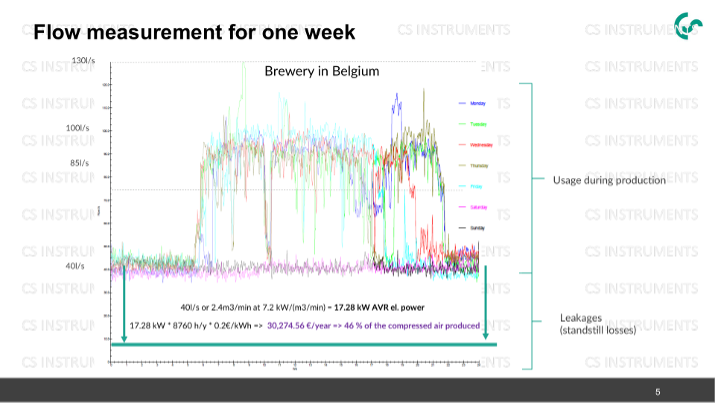
Weekly measurement: base load, production consumption and losses during downtime become apparent.
When prioritising, it is not the number of leaks alone that counts, but the volume flow of the loss and the resulting costs. Large, dominant leaks should be documented and repaired first. The area is then measured again, as smaller leaks that were previously masked may become visible.
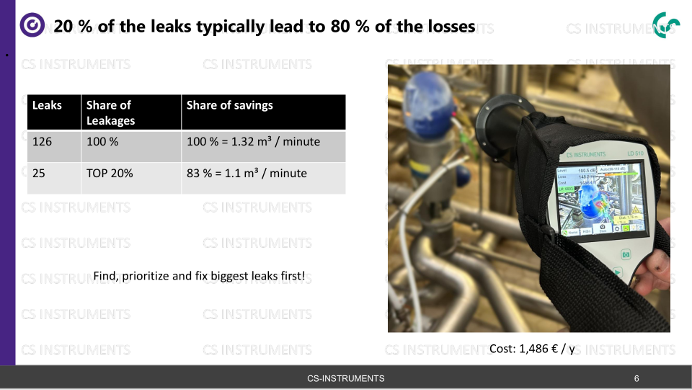
Prioritisation: The largest leaks often account for the largest proportion of losses. Therefore, identify, prioritise and rectify the most significant leaks first.
The camera shows where a loss is occurring. Whether the measure has improved operations can only be determined through monitoring. Consumption, base load, pressure level and specific output should be compared before and after the measure. Base load and peak load must be considered separately so that savings are not misjudged due to fluctuations in production.
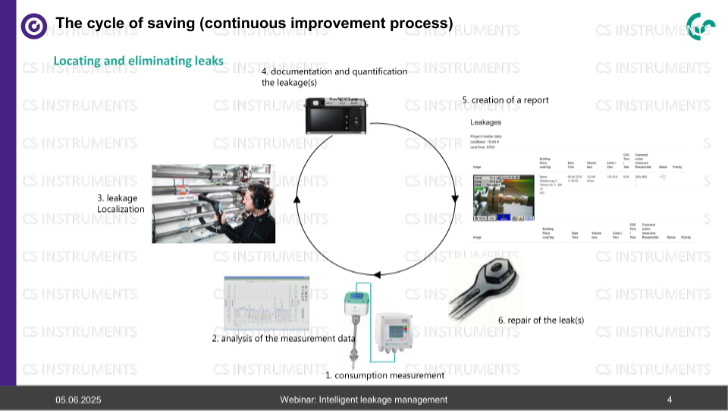
Continuous improvement process: consumption measurement, analysis, leak detection, documentation, reporting, repair and re-evaluation.
Once the demand-side factors have been taken into account, the generation side can be reliably assessed. Key performance indicators include compressor power, air delivery, system pressure, pressure losses, running and idle times, and specific power. The pressure band, compressor control, load distribution and pressure losses can then be optimised in line with actual demand.
| Level | Metrics | Typical measures | Validation |
| Demand Side: Identifying and reducing consumption | Flow, consumption, base load, load profiles, proportion of leakage, pressure level at the consumer | Locate and repair leaks, reduce venting, check consumption, assess pressure reduction. | Compare consumption before and after the measure; consider base load and peak load separately. |
| Supply Side: Optimising generation and specific output | Compressor capacity, air output, system pressure, pressure losses, running/idling times, specific output | Optimise the pressure band, check the compressor control system, improve load distribution, reduce pressure losses. | Optimise the pressure band, check the compressor control system, improve load distribution, reduce pressure losses. |
If compressors are designed to cope with an increased demand caused by leaks, losses are factored into production on a permanent basis. Following a subsequent repair of the leak, the system may operate in unfavourable partial-load ranges. This results in increased idle times, excessively high minimum supply volumes, inefficient load/idle cycles and a pressure band that does not match actual demand.
Monitoring ensures that the improvement achieved is not merely estimated, but actually measured. Flow, pressure and performance data show whether repairs are effective, whether new leaks are developing and whether production should be adjusted following demand-side optimisation. Compressed air purity remains a separate but related issue for quality-critical applications such as food, pharmaceuticals and semiconductors.
| Objective | Relevant solutions | Benefits |
| Reduce consumption | Flow measurement, DS 500, CS Network | Monitor compressed air consumption, analyse load profiles and demonstrate savings |
| Locating leaks | LD 500, UltraCam, LeakCam 600 | Identify, document and prioritise leak points |
| Manage repairs | Leak Reporter | Manage leaks, track repair status and assess potential savings |
| Optimise compressed air generation | CMM 500, performance measurement, pressure measurement | Design and evaluate compressor operation to meet demand |
| Ensure compressed air quality | Dew point, residual oil and particle measurement | Monitoring compressed air quality and enhancing process reliability |
Create an ISO 50001 report with leak detector LD 500 with camera and leakage calculation (l/min and costs in €).

uses 30 MEMS microphones for the Calculation and visualisation of the ultrasound image. The device also makes inaudible ultrasound audible.

Detects multiple leakages simultaneously with globally unique Power Beam Forming. 4th generation technology - also suitable for other gases. Helps to locate and repair leaks - including cost estimation and ISO 50001 documentation.

For detailed ISO 50001 reports. Gives an illustrated overview on the detected leaks and possible savings.

The CS Leak Reporter Cloud Solution combines the functionalities of the CS Leak Reporter V2 with a browser-based cloud system.

The CMM 500 can be used directly downstream of the compressor for measuring in wet compressed air or as a compressed air meter for billing in dry compressed air.

For measuring immediately downstream of the compressor in moist air up to +180 °C

Measuring range 2 to 224 m/s / 600 m/s (Compressed air / gases) or 0.04 to 500 mbar differential pressure for Gases.

Measuring range: 2 to 224 m/s / 600 m/s (Compressed air / gases) 0.04 to 500 mbar Differential pressure for Gases.