Inspecting Technical Gases Using Ultrasound

Effect of Gas Type on Leak Detection

1. Does an ultrasound camera detect the gas itself?

No. An ultrasound camera does not detect the gas itself, but rather the ultrasonic waves generated by the flow patterns at the leak site. Whether a leak becomes visible therefore depends primarily on the pressure difference, the geometry of the leak, the flow rate, the measurement distance, and the environmental conditions.

The type of gas primarily influences the economic and safety implications of a leak. With compressed air, the focus is usually on energy losses, whereas with nitrogen, argon, CO₂, oxygen, helium, or methane, process stability, media costs, occupational safety, or product quality are often the decisive factors.

2. Why Turbulent Flow Is Crucial

In industrial leak detection, distinguishing between audible sound and ultrasound is crucial. Most production noises fall within the audible, low-frequency range. Leaks in compressed air and gas lines generate broadband turbulence with high-frequency sound components at small leak openings. Large leaks often generate additional audible sound; however, in production environments, this is frequently masked by machine noise.

Frequency RangeDescriptionSignificance in Industry
Audible sound (approx. 20 Hz to 20 kHz)Frequency range that can be perceived by the human ear.Noises from machines, motors, fans, and speech typically fall within this range
Ultrasound (> 20 kHz)A sound range inaudible to humansLeaks, partial electrical discharges, and other high-frequency events often generate ultrasonic components
Target frequency windowFor the measurement of selected frequency ranges within the ultrasonic spectrumEnables the suppression of interference signals and the targeted detection of relevant ultrasonic sources.

The ultrasonic sound generated by a leak is not caused by the gas itself, but by the turbulence that occurs when the gas escapes. The pressure difference, leak geometry, and the shape of the exit opening determine the sound intensity and the frequency spectrum of the generated ultrasonic waves.

Higher frequencies offer better spatial resolution due to their shorter wavelength. However, as the frequency increases, so does atmospheric attenuation, which reduces the achievable detection range. The choice of measurement frequency therefore represents a trade-off between resolution, range, and interference suppression. In many industrial applications, a frequency range around 40 kHz has proven to be favorable. In environments with interference, however, a different frequency window may yield better results.

3. Compressed Air vs. Industrial Gases

MediumAcoustic ClassificationSignificance for Users
compressed airIdeal primary application. Stable ultrasonic components are generated when there is sufficient differential pressure.Leaks increase energy consumption. After repairs, consumption should be verified through monitoring.
nitrogenDetectable if the pressure differential and turbulent outflow are sufficient.Relevant for inerting, packaging, electronics, and process applications. Be mindful of oxygen displacement and occupational safety.
argonDetectable with sufficient pressure and appropriate leak geometry.Small leaks can be economically significant because argon is frequently used as a process or shielding gas.
Carbon dioxideAcoustically detectable if the leak generates turbulent ultrasound.Evaluation based on costs, process control, ventilation, and occupational safety.
oxygenAcoustic localization is possible if the gas flow generates ultrasound.Observe special requirements regarding materials, cleanliness, and fire safety. Ultrasonic measurement does not replace a safety assessment.
HeliumLarger local leaks can be detected acoustically; extremely small leaks are often below the acoustic detection limit.A fast on-site method, but not a substitute for highly sensitive helium leak detection technology in the micro-range.
methaneAcoustically detectable only at sufficient pressure and with turbulent outflow.Ultrasound locates sound, not gas concentration or explosion risk. Approved gas detection and safety protocols remain paramount.

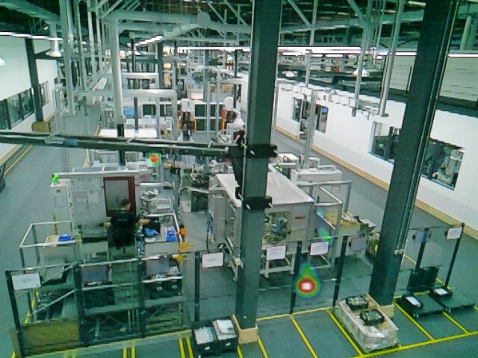
Large-scale production environment: Industrial gases and compressed air are evaluated acoustically based on the flow at the leak site, not on their chemical composition.

4. Nitrogen Leaks

Nitrogen leaks can be detected acoustically if there is a sufficient pressure difference and turbulent outflow. However, the assessment differs from that for compressed air: In addition to media costs, process safety, inerting, protective gas atmospheres, and oxygen displacement must be taken into account. Ultrasound identifies the sound source but does not measure the gas concentration in the room.

5. Argon and Carbon Dioxide Leaks

Argon and CO₂ can generate ultrasonic waves if there is a sufficient pressure difference and the leakage geometry is appropriate. Even small leaks can result in significant costs if the gas is used as a process gas or shielding gas. In the case of CO₂, additional considerations regarding ventilation and occupational safety must also be taken into account. Acoustic leak detection aids in locating leaks but does not replace a safety assessment of the system.

6. Oxygen: Separate technical detection and safety assessment

Oxygen applications require special attention to material compatibility, cleanliness, fire safety, and system approvals. An ultrasound camera operates passively and does not require a test gas; however, acoustic detection is not a substitute for a safety assessment. Operational guidelines and approvals must be followed before conducting measurements.

7. Helium: Ultrasonic vs. Helium Leak Detection

Helium is frequently used for highly sensitive leak tests. Ultrasonics can quickly locate larger localized helium leaks on-site when turbulent outflow occurs. However, extremely small leaks that fall below the acoustic detection limit remain a use case for highly sensitive helium leak detection technology.

8. Methane: Acoustic detection is no substitute for gas detection technology

For methane or other flammable gases, the following applies: An ultrasound camera detects sound, not the risk of explosion. This method can only detect an acoustic source if there is sufficient pressure and turbulent outflow. Approved gas detection technology, explosion protection concepts, and plant approvals take precedence.

9. Measurement Strategy for Technical Gases

1.Determine the medium, pressure level, process risk, and approvals before taking the measurement.
2.Prioritize pressure-bearing components, valves, regulators, flanges, couplings, and hoses.
3.Start from a safe distance and move closer to the target component if signals are weak.
4.Use FFT and frequency windows when other ultrasonic sources are present.
5.Check multiple viewing angles for directional radiation.
6.For safety-critical gases, strictly separate ultrasonic measurement from gas detection and occupational safety assessments.