
LD 500/510 - Leak detector with camera
Due to the integrated camera and the available accessories our starter kit for leak detection enables reliable leak detection as well as compressed air leakage calculation and reporting according to ISO 50001.
Not all ultrasonic leak detection methods rely on a camera. Conventional ultrasonic leak detectors convert the ultrasonic waves generated by leaks into an audible signal. This method has been used by CS INSTRUMENTS in numerous industrial applications, including with the LD 300, LD 400, LD 450, and LD 500 devices.
Ultrasonic cameras supplement acoustic detection with visual sound source localization. The calculated sound sources are displayed as hotspots directly in the camera image. This makes it easier to identify individual components, distinguish between multiple sound sources, and document leaks.
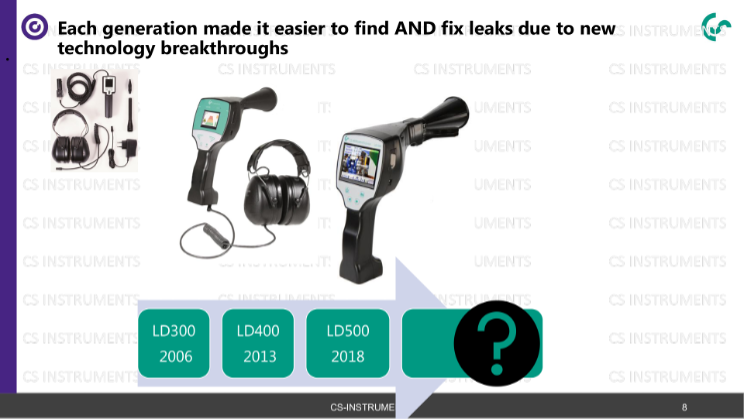
Development of CS INSTRUMENTS’ leak detection devices: Each generation makes it easier to locate, document, and repair leaks
The LD 500 makes the ultrasonic sound generated by a leak audible. To do this, the ultrasonic signal is converted to an audible frequency range using the heterodyne method. The characteristic sound of the leak is preserved, allowing the user to locate the sound source acoustically.
The UltraCam LD 500/510 combines audible ultrasonic detection with visual sound source localization. In addition to the audible leak signal, the sound source is displayed as a hotspot in the camera image. This allows acoustic guidance and visual identification to be combined.
The LeakCam 600 was developed for applications involving long measurement distances, multiple simultaneous sound sources, and increased requirements for noise suppression. The system is based on 64 digital MEMS microphones, power beamforming, and FFT-based frequency analysis.
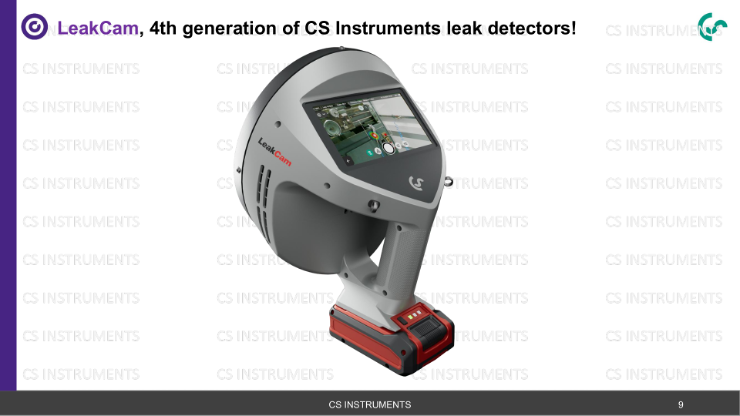
LeakCam: the next generation of leak detection devices from CS INSTRUMENTS—visual localization via acoustic camera.
| System / Accessories | Technical Principle | Typical Benefits |
| LD 500 with Directional Horn | Piezo ultrasonic transducer with acoustic focusing within the beam angle of the directional horn. | Piezo ultrasonic transducer with acoustic focusing within the beam angle of the directional horn. |
| LD 500 with gooseneck | The sensor is positioned very close to the pipe. | In the event of strong interference, measurements can be taken at a distance of just a few centimeters; extraneous sound is spatially reduced. |
| LD 500 with parabolic mirror | The parabolic reflective surface focuses parallel-incident ultrasonic waves at the sensor’s focal point. | High directivity and long-range detection when the sound source is correctly targeted. |
| UltraCam LD 500/510 | 30 MEMS microphones plus audible feedback of the ultrasound. | Combination of acoustic guidance and visual hotspot mapping. |
| LeakCam 600 | 64 digital MEMS microphones, large array, power beamforming, FFT frequency management. | High-performance solution for large systems, multiple sources, interference suppression, and visual documentation. |
| Leak Reporter | Software-based documentation, prioritization, and tracking. | Repair planning, cost-benefit analysis, and identification of potential savings. |
The LD 500 is particularly well-suited for close-range measurements, systematic inspection of pipes, and use with accessories such as goosenecks, directional funnels, or parabolic mirrors. The acoustic guidance helps the user pinpoint the location of sound sources by guiding them toward the leak site.
A camera is useful when leaks need to be quickly identified visually, when multiple potential sources are within the field of view, when certain areas of the system are inaccessible, or when documenting the issue with images is a priority. Visual identification reduces search time and minimizes misunderstandings during repairs.
The LeakCam 600 is particularly useful for large systems, overhead piping, complex environments with interference, multiple leaks within the field of view, and longer distances. Power beamforming and frequency management help separate sound sources of varying loudness and specifically reduce interference.
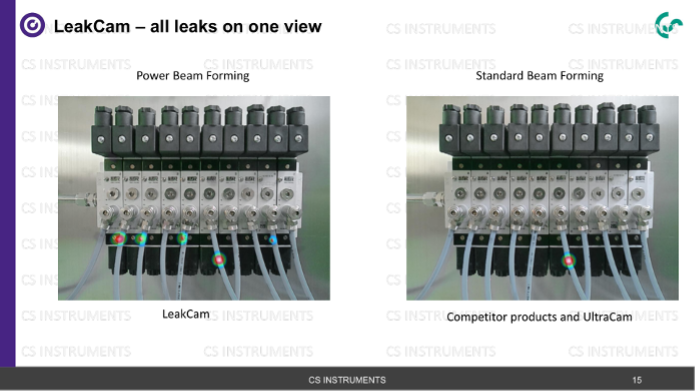
Power Beamforming vs. Standard Beamforming: Multiple leaks are more clearly visible with the LeakCam.
| Application | Recommended Solution | Advantage | Limit / Note |
| Close proximity, many components located close together | LD 500 with gooseneck | Sensor very close to the component; extraneous noise is reduced. | Without a camera image, visual identification is less straightforward. |
| Standard leak detection with documentation | LD 500 / LD 510 | Audible localization, image, leak calculation, and reporting. | The user follows the loudest signal. |
| Visual identification and audible signal | UltraCam LD 500/510 | Combines hotspot detection and acoustic guidance. | Standard beamforming has limitations when dealing with multiple sources of varying loudness. |
| Large facility, distance, multiple sources | LeakCam 600 | Power beamforming, 64 microphones, FFT, high image resolution. | Plan for a larger area and closer to the product; not always necessary for pure close-range searches. |
| Repair planning and cost savings analysis | Leak Reporter | Prioritization, report, repair status. | Requires consistent data maintenance and a repair process. |
Due to the integrated camera and the available accessories our starter kit for leak detection enables reliable leak detection as well as compressed air leakage calculation and reporting according to ISO 50001.

Detects multiple leakages simultaneously with globally unique Power Beam Forming. 4th generation technology - also suitable for other gases. Helps to locate and repair leaks - including cost estimation and ISO 50001 documentation.

uses 30 MEMS microphones for Calculation and visualization of the ultrasound image. The device also makes inaudible ultrasound audible.

The CS Leak Reporter Cloud Solution combines the functionalities of the CS Leak Reporter V2 with a browser-based cloud system.

For detailed ISO 50001 reports. Gives an illustrated overview on the detected leaks and possible savings.