
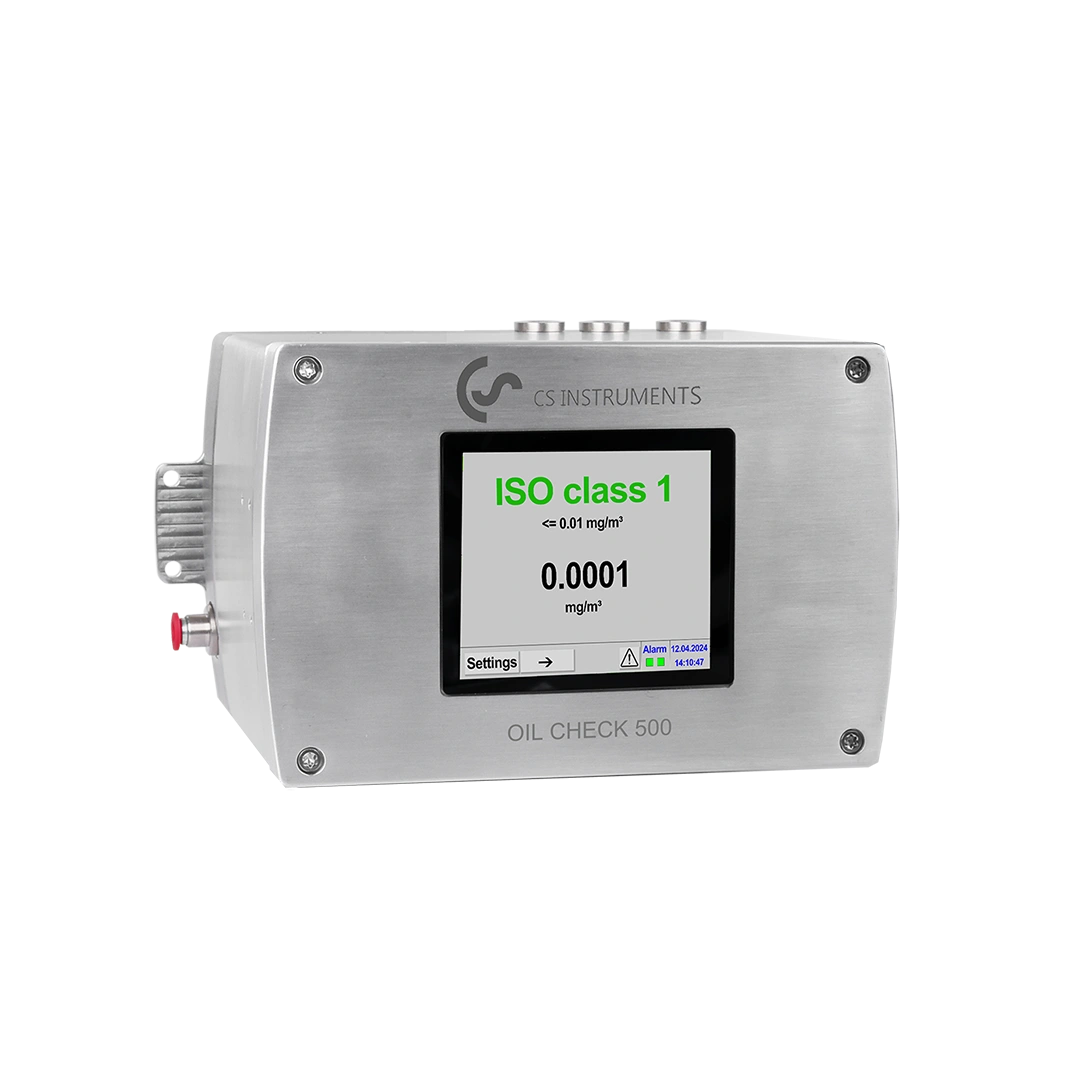
OIL CHECK 500 – Residual oil vapor analyzer for compressed air and gases
Maximum safety through maximum sensitivity - continuous monitoring of the critical parameter vaporous residual oil content in accordance with ISO 8573.
Who needs oil-free compressed air and why?
Oil contamination in compressed air can cause production downtime and loss of quality, as the pipeline network, production facilities and end products can be contaminated. Oil-free compressed air is therefore particularly important in the food and beverage industry, the pharmaceutical industry and in medical applications. Other applications include chemical and petrochemical process engineering, electronics and semiconductor manufacturing, automotive painting, the paper industry and textile manufacturing. In industries such as brewing, where nitrogen is used to prevent oxidation and maintain pressure, the purity of compressed air is crucial. Oil-free compressed air, combined with nitrogen generators, can ensure product quality and reduce costs by producing nitrogen in-house.
Oil-free versus oil lubricated
When selecting a compressor, it is important to differentiate between "oil-lubricated" and "oil-free" solutions. Both types of compressor supply compressed air, but differ in their lubrication. Oil-lubricated compressors use oil to lubricate the internal components, while oil-free compressors use self-lubricating or pre-lubricated materials to keep the parts moving efficiently.
When is "oil-free" the right choice?
Oil-free compressors are particularly suitable for industries where even the smallest amounts of oil can damage equipment or spoil products. This applies to the pharmaceutical, food and beverage, electronics, laboratory and similar industries. However, if oil is not a critical factor in your applications, an oil-lubricated or "technically oil-free" system could be an option. Oil-free compressors are more expensive to purchase and more energy inefficient than oil-lubricated compressors. It is therefore crucial to ensure that the compressed air from your compressors meets your quality requirements in order to avoid unnecessary costs and energy losses.
Limitations of oil-free compressors
Oil-free compressors do not necessarily deliver ISO quality class 1 compressed air, as they draw in ambient air that may contain hydrocarbons. Activated carbon filters and activated carbon absorbers are often installed to remove these hydrocarbons. These filters become saturated over time and can release hydrocarbons again.
Types of intake for air compressors
Compressed air treatment to comply with ISO 8573-1 classes
To improve compressed air quality after compression and achieve higher ISO 8573-1 classes, several steps are necessary:
These measures ensure high compressed air quality and meet the requirements of the ISO 8573-1 standard.
Continuous monitoring and measuring
With the OIL CHECK 500, you can continuously measure and document the purity of your compressed air and prevent expensive production downtime. These measurements help you to assess the effectiveness of your compressed air treatment and to change the activated carbon filter/bulk filter as required.
The graph shows the measured values of the OIL CHECK 500 after installation and switching the intake from external to internal intake in a compressed air system with an oil-free compressor and refrigeration dryers.
Results:
With its high sensitivity and three calibration points in class 1, the OIL CHECK 500 precisely indicates even minimal changes in the oil vapor values. Despite the increase, the values remain within the highest purity class, which underlines the importance of the intake and the need for continuous monitoring to ensure the highest quality standards.

| SCENARIO | PERMITTED |
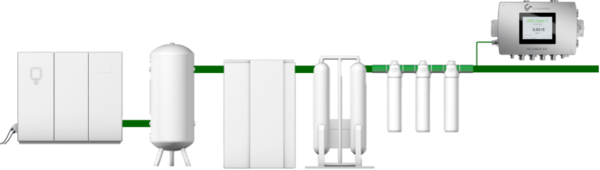
(1) compressor, (2) tank, (3) refrigeration dryer, (4) desiccant dryer, (5) filter stage incl. Act. Carbon |  |
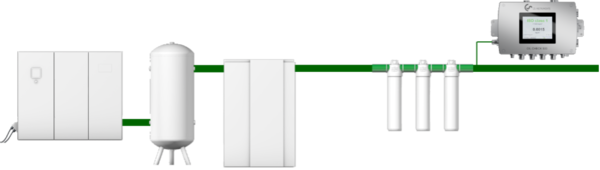
(1) compressor, (2) tank, (3) refrigeration dryer, (4) filter stage with activated carbon | |
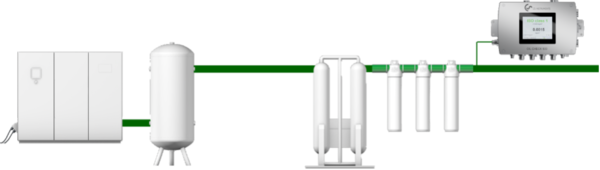
(1) compressor, (2) tank, (3) desiccant dryer, (4) filter stage with activated carbon | |
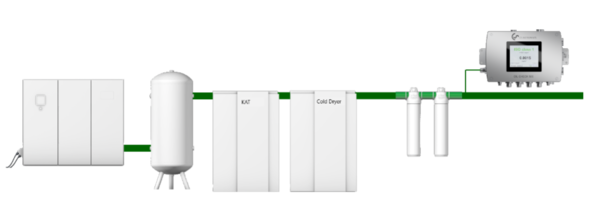
(1) compressor, (2) tank, (3) catalytic converter, (4) refrigeration dryer, (5) filter stage | |
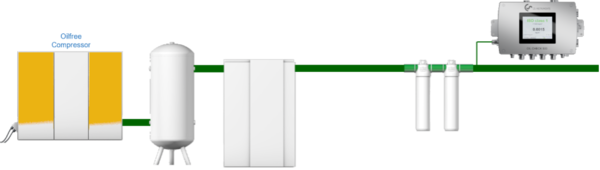
(1) Oil-free compressor, (2) tank, (3) refrigeration dryer, (4) filter stage | |
| SCENARIO | NOT PERMITTED |
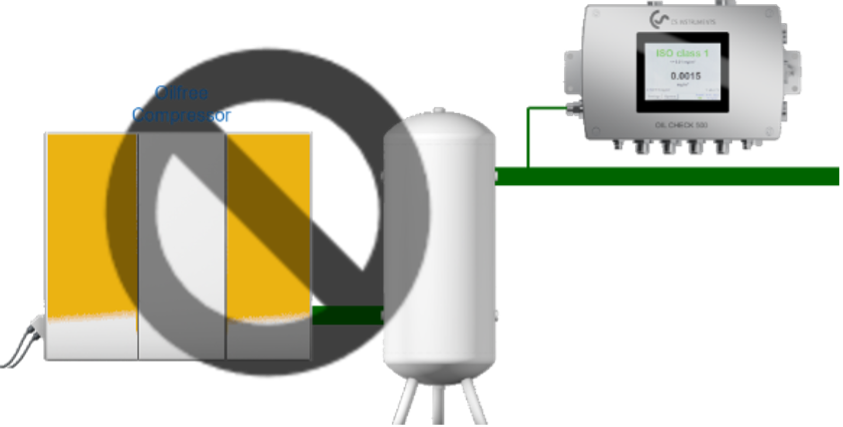
(1) Oil-free Compressor, (2) Tank, (3) OIL CHECK 500 |  |
(1) Compressor, (2) Tank, (3) OIL CHECK 500 | |
Would you like to continuously monitor the quality of your Compressed air?
Use the OIL CHECK 500 to continuously monitor your Compressed air quality and ensure that your production always meets the highest standards. You can find more information on the product page or call us for a personal consultation and customized solutions for your compressed air monitoring. Take the initiative now and optimize your production processes!
Maximum safety through maximum sensitivity - continuous monitoring of the critical parameter vaporous residual oil content in accordance with ISO 8573.

Ideal instrument for dew point measuring for all kinds of dryers.

The highly precise optical particle counter PC 400 measures particles from a size of 0.1 µm and is therefore suitable for monitoring of the compressed air quality class 1 ISO 8573.