
FA 500 - Dew point sensor with integrated display and alarm relay
Dew point sensors for various types of dryers with integrated Display and alarm relay.
Reliably monitor the dew point, residual oil and particles – wherever hygiene, product safety and audit compliance are crucial.
Compressed air is a key operating medium in the meat industry. It may come into direct contact with unpackaged meat or influence processes close to the product. What matters here is not only the treatment in the compressor room, but the actual quality at the point of use.
Three parameters are particularly relevant for assessing compressed air quality: pressure dew point, residual oil and particles. The measurement location and monitoring logic vary depending on the specific application.

The pressure dew point is an important parameter for the hygienic assessment of compressed air, as humidity can promote the growth of microorganisms. The growth of microorganisms in compressed air slows as the pressure dew point falls and ceases entirely below –26 °C (BCAS R102-1). For this reason, a Class 2 pressure dew point of –40 °C is often targeted.

The residual oil content should also be monitored centrally following treatment. The reason for this is that the air is significantly warmer after passing through the compressor than it is in the distribution network and in the production areas. In meat processing, temperatures are often around 10 °C, and in cold stores they are significantly lower still.
This increases the risk of gaseous oil components condensing in the cooler network and accumulating there. This is precisely what must be avoided, as it can lead to oil carry-over. Centralised residual oil measurement is therefore an essential component in ensuring hygienically safe compressed air.
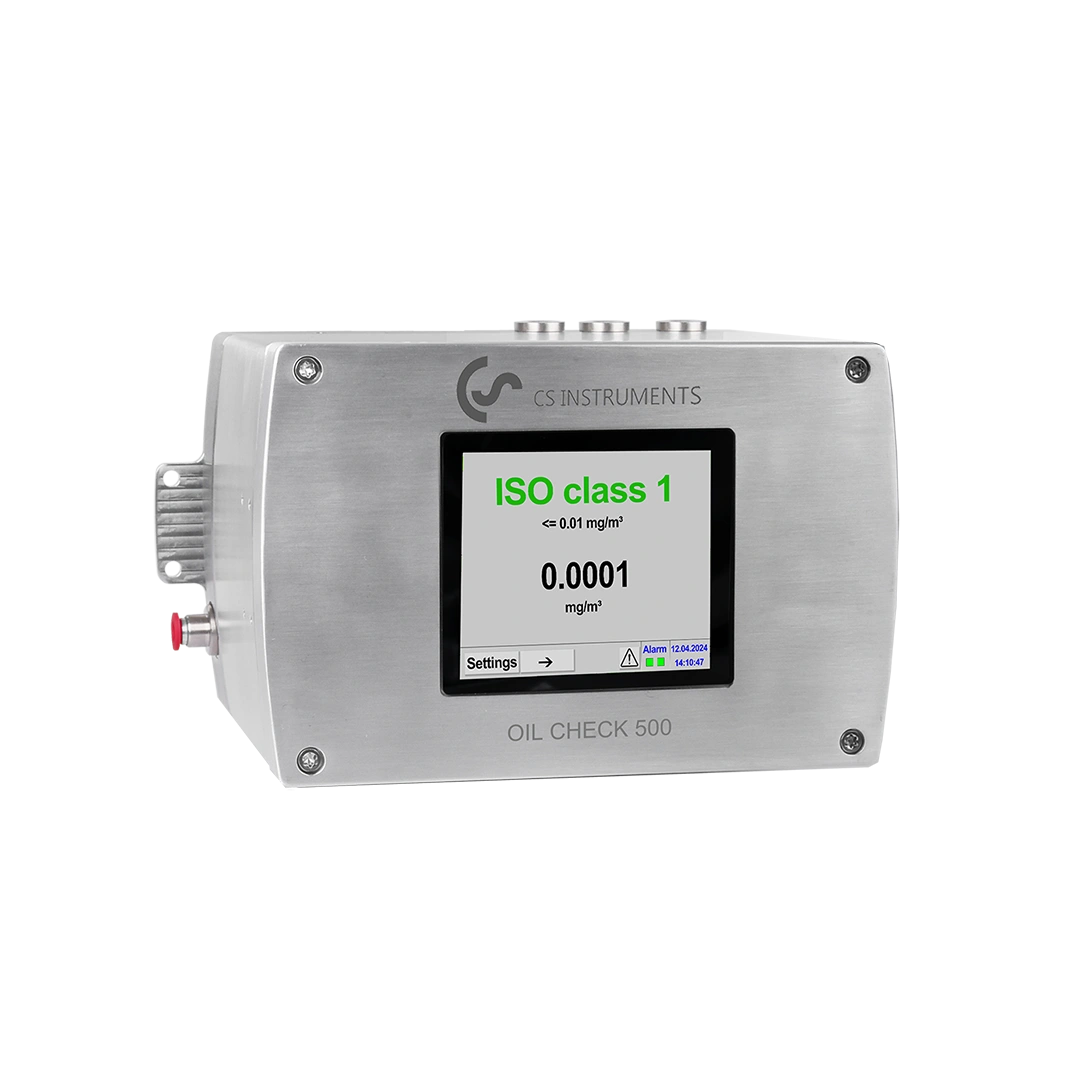
Maximum safety thanks to maximum sensitivity - continuous monitoring of the critical parameter vaporous residual oil content in accordance with ISO 8573.

Particles must be assessed differently from the dew point and residual oil. They may not only originate from the generation process, but may also arise within the distribution network itself, for example due to corrosion, abrasion or filter problems. This is why the measurement of particles at the point of use is particularly informative.
The purity in the compressor room is therefore not automatically the same as the purity at the consumer point. For a reliable assessment, the actual conditions must be taken into account at the point where the compressed air is used in the process.

The high-precision, optical Particle counter measures Particles from a size of 0.1 µm and is therefore suitable for monitoring Compressed air quality class 1 ISO 8573.
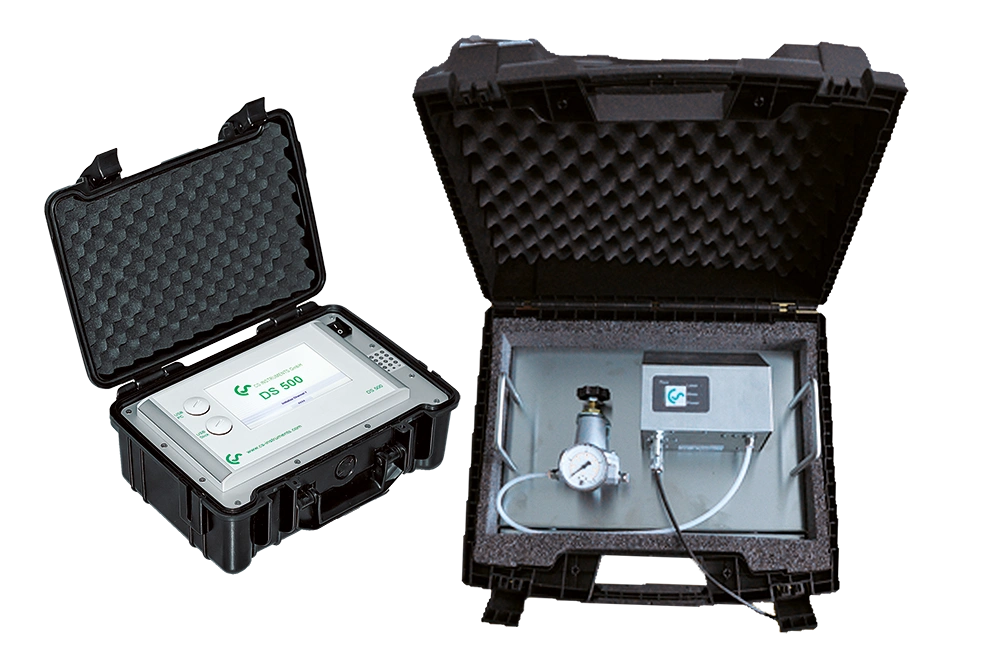
The PC 400 Particle counter up to 0.1 µm for Compressed air / gases as an ideal Portable solution in a service case.
At the latest during an audit, compressed air quality becomes a subject requiring inspection. Current standards require a risk-based approach to process media. The following applies to compressed air that comes into direct contact with food or primary packaging: it must not pose a risk of contamination and must be monitored.
It is important to note that the standards do not generally specify blanket numerical values, but require a justified determination for each extraction point. In practice, this results in:
• a comprehensive register of all extraction points,
• an assessment of the type of contact,
• the specified purity class,
• a test plan specifying the point of measurement, method and frequency,
• and a defined procedure for dealing with deviations.
In this way, compressed air quality is not only technically controlled but also documented in a manner suitable for audit purposes.

Compressed air may already be contaminated at the point of intake, or may become contaminated during the processes of compression, treatment, storage and distribution. The main contaminants of concern are particles, water, oil and micro-organisms.
It is particularly important to note that the quality in the compressor room is not automatically the same as the quality at the point of use. Pipes, storage tanks, filters, hoses and points of use can subsequently alter the air quality within the network. Therefore, compressed air must be assessed at the point where it actually plays a role in the process.

The following standards are particularly relevant to compressed air quality in the meat industry:
Compressed air quality in the meat industry is a matter of hygiene, process control and compliance. Three factors are crucial: centrally monitoring the dew point and residual oil content after treatment, checking for particles at the point of use, and clearly documenting the requirements for each application. In this way, compressed air becomes a controlled component of the hygienic process chain.
